
We're Teaching Toddlers "Yet." What About the Thirteen-Year-Olds?
On growth mindset, children's media, and the students sitting in front of the hardest test of their lives
This morning, my older daughter was sitting between my knees on the bathroom floor, head tipped forward, while I did her hair before school. She was watching Gabby’s Dollhouse on my phone, which I have written about elsewhere and not kindly. The theme song doesn’t so much get stuck in my head as move in and refuse to leave, like a houseguest who found the WiFi password. I wasn’t really watching. I was thinking about my first session of the day, or what was in the fridge, or nothing at all, doing the part on autopilot, and then I heard Gabby say something from the phone, quietly to herself mid-episode: I don’t know how to do this…yet.
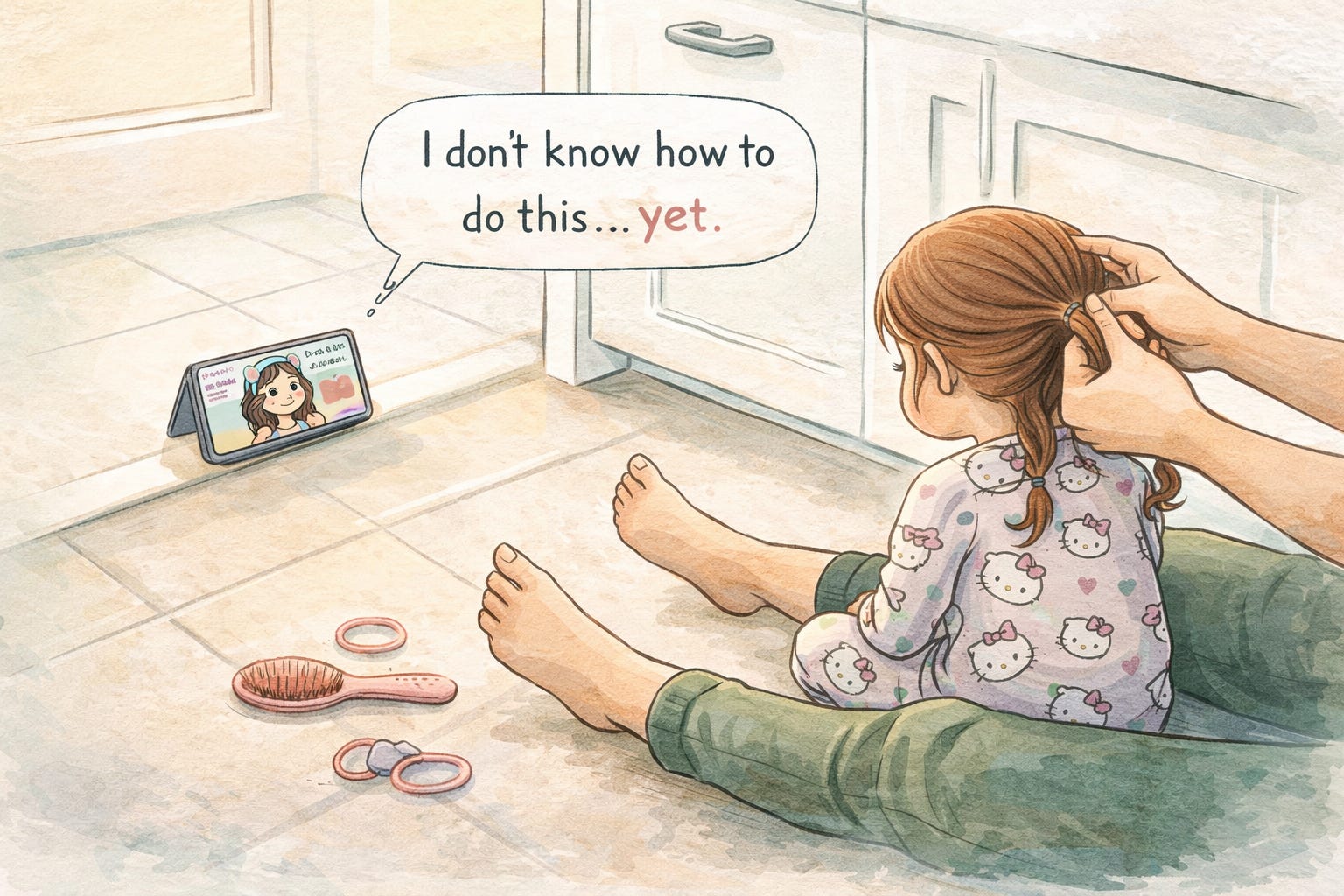
My daughter is three, and she already has the word. Not as a lesson she was taught, not as something she had to look up, just as part of her working vocabulary for when she hits something she can’t do. She absorbed it somewhere, the way she absorbed “please” and “sorry” and “actually,” and now it’s just there, available, when she needs it.
I didn’t have it until I was thirty-something years old.
In 2020, in the middle of the pandemic, I was enrolled in a professional certificate program through the Landmark College Institute for Research and Training, a postbaccalaureate certificate in Learning Differences and Neurodiversity, with a specialization in Executive Function, taught by researchers who’ve spent decades studying how neurodiverse learners actually think. I was doing it on Zoom in the apartment I was also tutoring out of, while my husband (who, at the time, had quite suddenly graduated from boyfriend to live-in boyfriend), got his Masters in Data Science fifteen feet away.
At some point in the curriculum, they had us watch a video with hand-drawn whiteboard animation where a marker sketches out ideas in real time while a voice narrates. The voice in this particular video was Carol Dweck’s, and she was talking about fixed versus growth mindset and the difference between students who, when they encounter something they can’t do, conclude that this is information about their permanent capabilities, and students who understand that not being able to do something yet is just a description of where they are right now. She talked about the students who had been praised so consistently for being smart that the first real obstacle they hit felt like exposure.
I sat at my desk with my headphones on and recognized myself in a way that was both clarifying and somewhat embarrassing given how old I was. I had always been a good student: teachers described me as bright, quick, a pleasure to have in class. I went to Horace Mann and graduated cum laude. But in 9th grade, Biology didn’t come as easily as everything else had and without any explicit decision-making I could point to, I concluded I wasn’t a science student. I took Chemistry over the summer before 10th grade and Physics over the summer before 11th, which freed me up, I told everyone, to take the classes I was actually interested in during the year: Contemporary Art History and Italian in 10th grade, Acting Seminar in 11th. This was true. It was also a cover story. The real reason was that I didn’t want to be in a room where things were hard and everyone could see it.
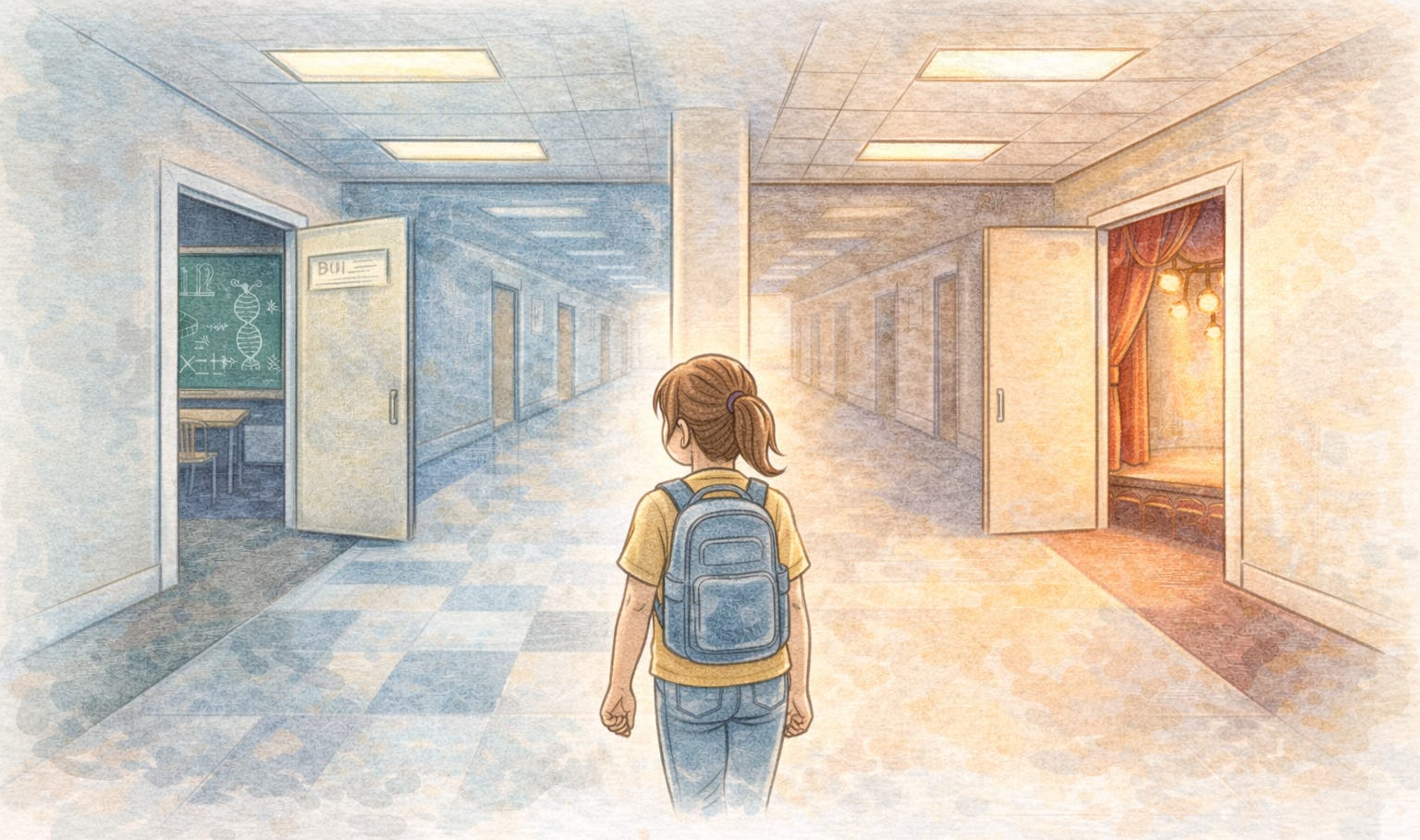
Nobody had given me a word for what was happening or told me it was a pattern with a name and a fix. I just thought I had limits and that I’d found them. I was learning this for the first time sitting alone at a desk with headphones on in a shuttered city, at thirty-something years old.
The thing I’ve kept turning over ever since is that the word didn’t exist when I was growing up, not in the form children are supposed to absorb it. Carol Dweck published Mindset in 2006, which is when fixed versus growth mindset got a name and a framework, but the word “yet” specifically—the one my daughter has, the one that’s now apparently just ambient in a three-year-old’s vocabulary—came later, and it came through a very particular pipeline.
In September 2014, Dweck gave a TEDx talk called “The Power of Yet” that opened with a Chicago school that grades students “Not Yet” instead of failing them, and the talk almost immediately went viral in education circles. That same month (not a coincidence), Sesame Street aired a segment with Janelle Monáe performing a song called “The Power of Yet,” which won a Daytime Emmy, with Elmo, Cookie Monster, Big Bird, and the whole gang. So Carol Dweck went from TEDx to Sesame Street in about a month, which is about as fast as an academic framework has ever traveled into children’s culture.
The groundwork had been laid before that. Daniel Tiger’s Neighborhood premiered in 2012 and its whole DNA is growth mindset—the strategy songs, the “keep trying, you’ll get better” refrain—but without the specific vocabulary, which is its own interesting pedagogical choice. Bluey does it with even less scaffolding; there’s an episode in the first season where Bluey tries to ride her bike, fails, watches other kids struggling with their own hard things, and tries again, but nobody sings about it or explains what you’re watching, the show just trusts you. By 2020, The Magical Yet, a picture book that personifies “Yet” as a creature that follows every child from birth, was an NYT bestseller, arriving right at the start of the pandemic, which, in retrospect, tracks perfectly: an entire generation of parents who were suddenly homeschooling needed exactly this vocabulary, and it showed up on time. Gabby’s Dollhouse, much to my current chagrin, premiered in January 2021; its co-creators both came up on Blue’s Clues and have explicitly cited Dweck’s TED talk as foundational to how they built the titular character, and the “Power of Yet” became a recurring song in Season 6. The word is now in the culture for kids the same way learning to share is.
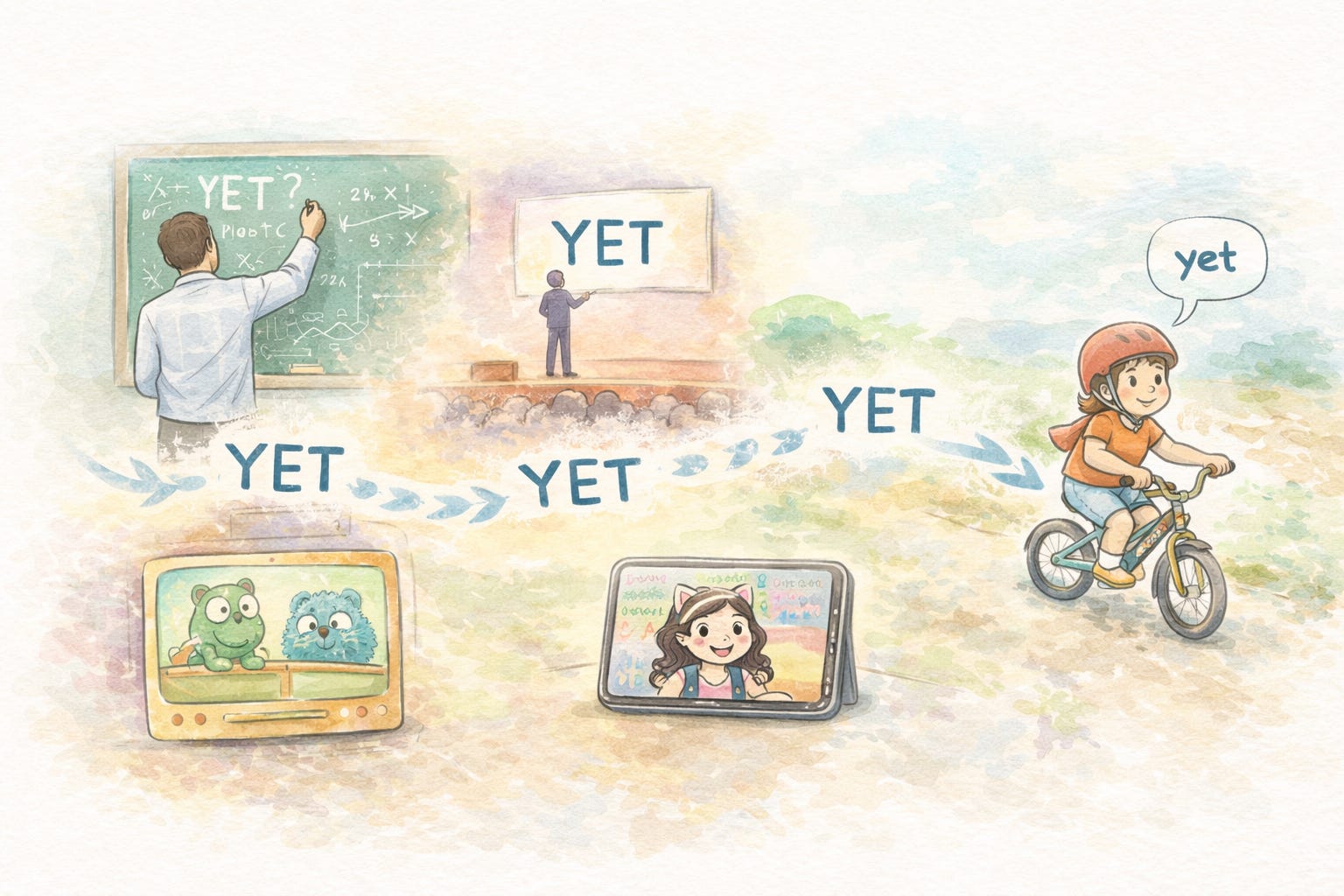
And then, somewhere around middle school, it stops. The framework doesn’t disappear, necessarily. it becomes classroom curriculum, teacher-facing lesson plans, posters on walls, Edutopia articles—but the cultural immersion ends. Nobody is making “the power of yet” content for fifteen-year-olds. There is no Gabby’s Dollhouse for high school seniors anxiously awaiting college decisions. The self-help workbooks for teens exist, but a workbook is remediation, not immersion. A workbook is something you do because you already know you have a problem. And what teen is really going to pick up a growth mindset workbook over scrolling TikTok? The adult versions—the TED talk, the RSA Animate video, the professional certificate program—are for people who already know they have a problem, which means you have to understand what’s happening to you before you can seek out the thing that explains it. Nobody hands the framework to you after age twelve. You have to find it on your own, if you find it at all.
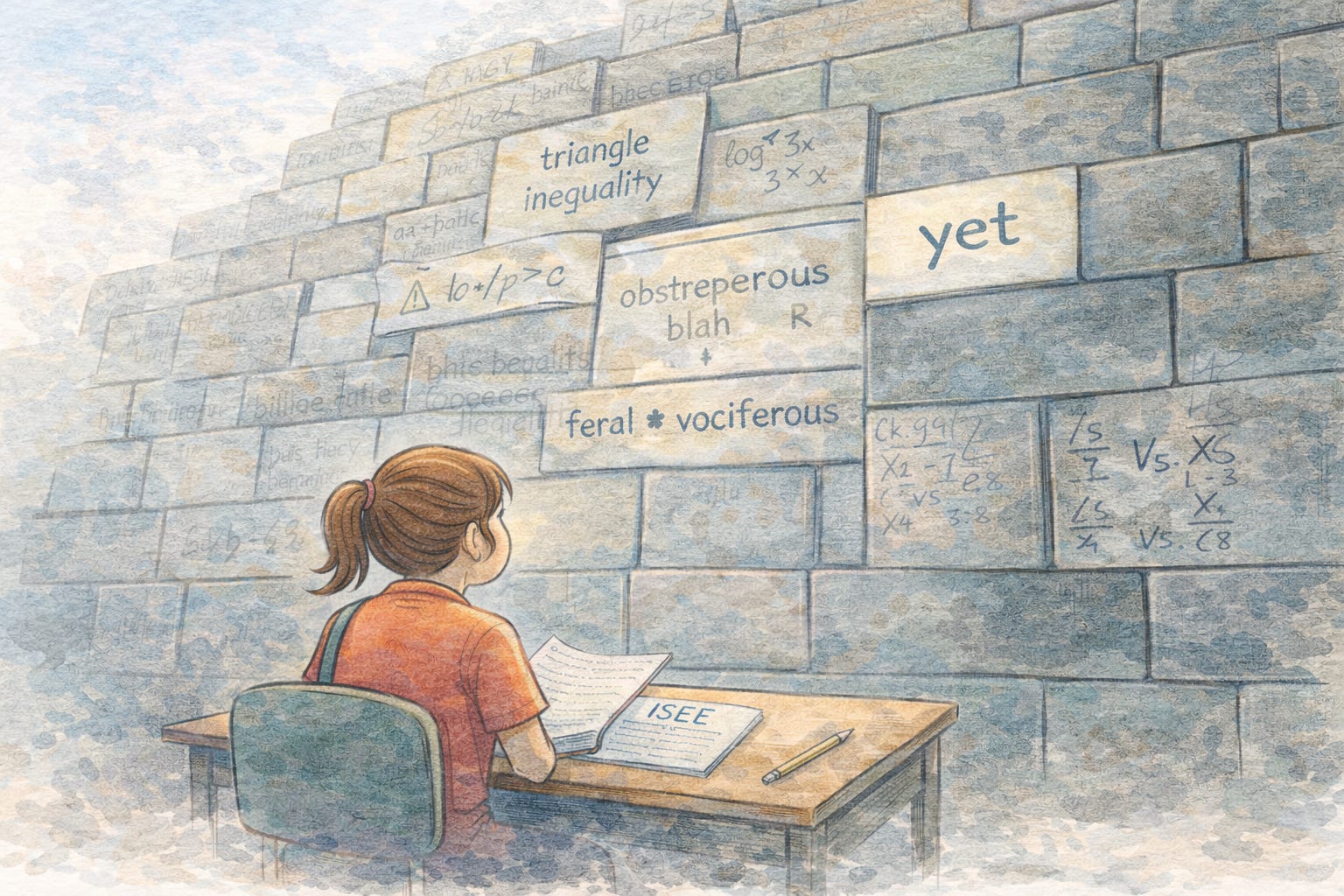
The ISEE (the Independent School Entrance Exam, required by most private schools in New York for students applying to grades 2 through 12) tests above grade level. A fifth grader taking the Lower Level will encounter math that won’t be formally taught until seventh or eighth grade; an eighth grader taking the Upper Level will see Algebra II and quantitative comparisons and a vocabulary section that assumes a reading life most kids simply don’t have. The test is engineered to put students in contact with material they don’t know, which means that every kid who sits down with an ISEE practice test is going to hit a wall at some point, guaranteed, by design.
The students who struggle most when they hit that wall are not the ones who don’t know the material. They’re the ones who’ve been told their whole lives that they’re smart. A kid who has sailed through elementary school on consistent praise has often never had the experience of genuine not-knowing. They’ve always been able to figure things out, teachers have called them gifted, and parents have organized an identity around their academic capability. Then, they sit down with the ISEE and encounter a triangle inequality rule that isn’t formally taught until ninth grade and something in them breaks a little. Not dramatically. Quietly, internally, the way it once broke in me. They conclude it means something about them rather than something about the test, and I spend a significant portion of my sessions not teaching the math but unteaching that conclusion, telling a twelve-year-old that the difficulty is structural, not personal, that the test is designed to put them here, that the word for what they’re experiencing isn’t failure.
I am currently working with a seventh-grader, whom we’ll call Beatrix, on MathChops, a game-based math platform I use with ISEE students. We were doing a level challenge, and she failed it twice, and at some point, I heard her exhale in the specific way that means I’m done, this is proof of something. We went back through the concepts she’d missed—the triangle inequality rule, a frequency table problem—and she tried again and passed it clean, not one wrong. I asked if it had been driving her crazy. Yeah. And what happened? She fixed it. How? A pause: she kept trying. So even if something feels hard in the moment, I said, what’s eventually going to happen? And she said, without hesitating, I’ll get it. I told her she was a freaking rock star, because she is, and also because no one had handed her this framework recently. She’s thirteen, Daniel Tiger’s Neighborhood is a decade behind her, the songs are gone, and what she has is me in a tutoring session delivering at 45 miles an hour the vocabulary that should not have disappeared along with diapers.
The timing of the Landmark program sits in the middle of all of this for me. The curriculum kept returning to executive function, the set of cognitive skills that govern whether a kid can start something hard and keep going through it: planning, working memory, cognitive flexibility, the ability to shift when one approach isn’t working. The research on executive function in neurodiverse learners is about what happens when those systems don’t operate the way school assumes they do, but the more I sat with it, the more I understood that the students I see freeze tutoring sessions often aren’t neurodiverse; they’re fixed-mindset, which functionally produces the same kid. Someone sitting in front of a hard problem who shuts down and concludes the problem is information about who they are, rather than just a problem to be worked. Fixed mindset and executive dysfunction look almost identical from the outside. One is a belief system and one is a neurological profile, but they end up in the same place: a kid who can’t initiate, can’t persist, can’t separate the difficulty from the self.
The pandemic also interrupted the years when a lot of my current students were supposed to be getting whatever thin version of this framework school offers. A kid who was in fifth grade in March 2020 lost the tail end of the period when growth mindset is most present in their schooling and went straight into the years when it mostly disappears anyway, without the bridge. They lost both things at once.
I think about this on Friday mornings when I’m doing my daughter’s hair.
My daughter is going to grow up with this word as furniture: something absorbed so early it won’t feel like a lesson, just a fact, the way she knows not to stick her fingers in the outlet or that we don’t hit. It’ll be there when she needs it, which is the whole point of giving children a word before they need it rather than after. The machinery to do this exists now, which is genuinely new. A full decade of children’s media built on one psychologist’s research, refined and distributed through preschool shows and picture books and a Netflix series with a very aggressive theme song. It reaches kids at the age when they can absorb it as ambient fact rather than remediation.
What I keep thinking about are the kids who are thirteen or sixteen or eighteen right now. Who have spent their whole lives being called smart and are sitting in front of a test that was engineered specifically to find the edge of what they know, and who are concluding, quietly, in the particular internal way I once concluded, that they’ve found the edge of what they’re capable of. They haven’t. They’re just not there yet, and somebody has to say it. Right now, mostly, that somebody is me in a tutoring session, mid-sneeze, losing my pen.
The pipeline exists; it just doesn’t extend quite far enough.
Not yet.